

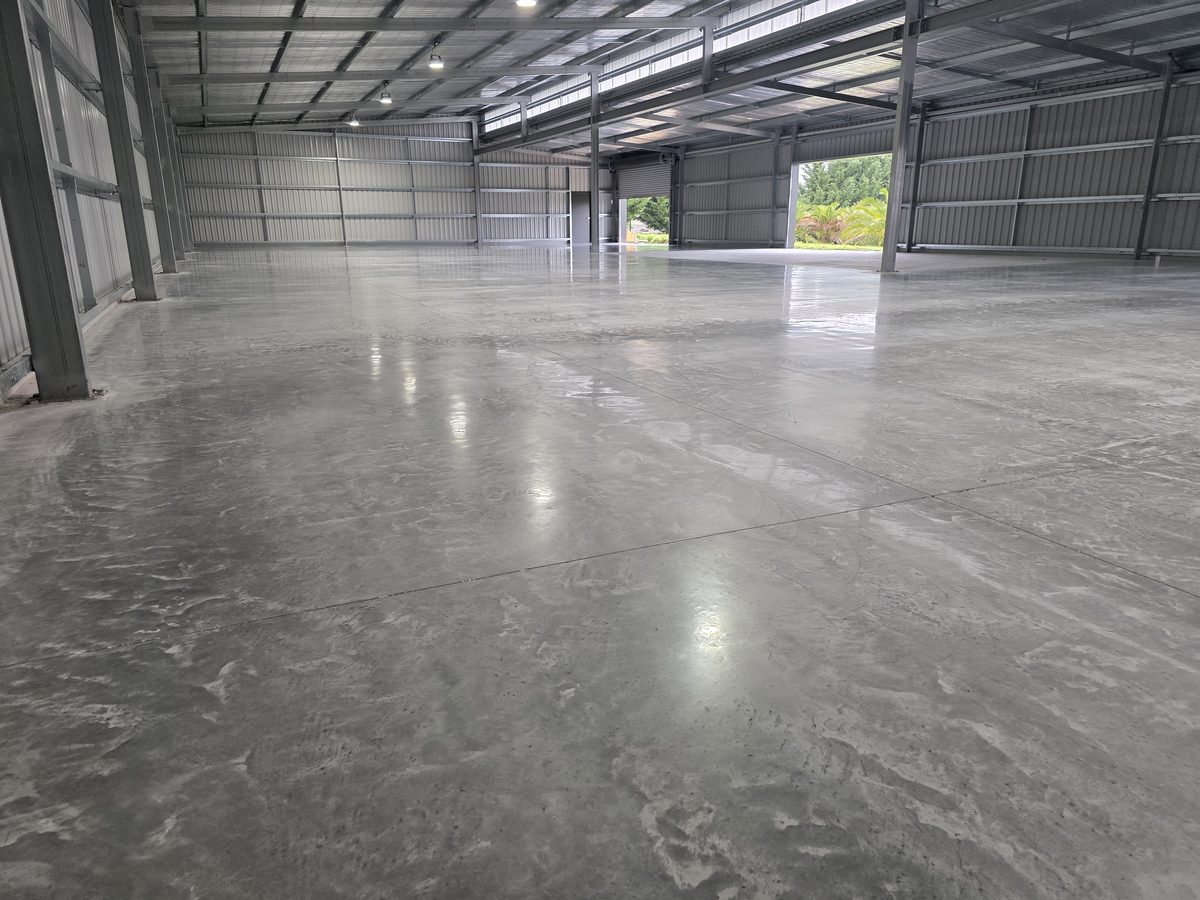
Factory-Spec Surface Polish
- Established 2018
- Over 20 years of building-industry experience
- More than 100 completed projects
- Fully insured
Factory polished concrete is a mechanically polished concrete system developed specifically for large industrial floors. It refines and densifies a sound, power-trowelled slab to produce a cleaner, brighter, harder-wearing surface — an industrial-performance floor rather than an architectural one. It is the practical option when a warehouse, factory or distribution centre needs a floor that looks sharp and cleans easily across thousands of square metres.
An industrial system, not an architectural one
This is not the same process as architectural polished concrete, and we would rather be straight about that than oversell it. Mechanically polished concrete for homes, showrooms and retail is about controlled aggregate exposure, a specified sheen and a highly refined appearance. Factory floor polishing is about performance across a large area: a cleaner, brighter, more durable working surface, delivered at a scale and cost that makes sense for industrial buildings.
The finish is genuinely attractive — an even, light-reflective industrial floor that lifts the whole building. It is simply aiming at a different target from a feature floor in a house.

What the process achieves
Industrial concrete polishing works with the existing slab rather than covering it:
- Mechanically refines the existing surface, lifting light soiling and early wear
- Densifies the concrete so the surface is harder and tighter
- Produces a cleaner, brighter finish that reflects available light
- Improves durability under heavy industrial traffic
- Improves cleanability — a tighter surface releases dirt more readily
- Improves abrasion resistance across traffic lanes and turning areas
- Produces an attractive industrial finish without a topical coating

Efficient across very large areas
Our specialised large-area methods allow us to complete large warehouse, factory and industrial floors far more efficiently than traditional full mechanical polishing methods. That efficiency is the whole point: it makes a polished floor realistic for buildings where a fully architectural process would take too long and cost too much.
We do not publish the specifics of how we achieve it. What it means for you is a shorter time on site for a given area, and a finish specified for industrial use.

Suitable applications
Warehouse concrete polishing suits buildings where the floor is both a working surface and part of the impression the building makes:
- Warehouse floors and distribution centres
- Factory floors and manufacturing facilities
- Industrial floors, workshops and plant rooms
- Commercial garages, showrooms and service workshops
- Large commercial facilities and trade counters
- Garage floors where a brighter, harder surface is wanted
What this finish needs from your slab
Factory-spec surface polish refines a surface that is already sound. It needs a power-trowelled, burnished slab — either new, or an older industrial floor that has been well looked after and still holds a good burnished finish.
Not every floor suits it, and that is better known early than late. Where a slab has been through a lot — previously ground or coated, worn through, uneven, or oil-soaked in the working bays — this process cannot bring it back. That does not mean nothing can: grind and seal, concrete grinding and floor levelling and preparation are built for those floors, and often give a better result on them than a polish would.
This finish is also at its best done early. On a new slab, polished before the building goes into service, it delivers everything the system is capable of. Once the burnished surface has been worn through, coated or soaked with oil, it cannot be brought back by this process — so if you have a new floor, it is worth doing now rather than later.
If you are not sure which your floor is, that is completely normal — send us a photo or we will come and look, and tell you honestly what it can do.
Process overview
The floor is cleaned and prepared, then mechanically refined through successive stages and densified so the surface hardens. The number of stages and the finish reached are set by the slab and the intended use, not by a fixed recipe.
The finish still reflects the concrete you have. Control joints, minor patching and colour variation can remain visible, and we will point that out before starting rather than afterwards.
How it compares with other industrial options
If the priority is simply to stop the floor dusting and to resist stains, without mechanically refining the surface, our concrete dust sealing is the more economical treatment. If you want a specific sheen, colour depth or chemical resistance from a coating, grind and seal applies a topical sealer over a ground surface. And if the floor is dirty rather than worn, factory and warehouse cleaning may be all it needs.
Why choose Premier Polished Concrete
Premier Polished Concrete was established in 2018 and is backed by over 20 years of building-industry experience and more than 100 completed projects. The business is fully insured. Based on the Mornington Peninsula, we service the Peninsula first and foremost, along with the Frankston and Langwarrin corridor, Gippsland and selected Greater Melbourne by arrangement.
Common questions
- Is factory polished concrete the same as architectural polished concrete?
- No. Both mechanically refine and densify the slab, but architectural polished concrete is specified around aggregate exposure and a particular sheen for a feature floor. A factory-spec polish is specified around industrial performance across a large area — brighter, harder and easier to clean, delivered efficiently.
- Can you polish an existing warehouse or factory floor?
- Sometimes — it depends on the floor. This finish refines a sound power-trowelled surface, so it suits newer slabs and older ones that have been well looked after and still hold a good burnished finish. Where a floor has been ground or coated before, worn through or soaked with oil, this process cannot bring it back, and grinding, grind and seal or levelling will serve it better. Send us a photo or we will come and look, and tell you which yours is.
- Will the finish be perfectly uniform?
- Not entirely. Polishing reveals the character of the existing concrete, so cracks, repairs, control joints and colour variation can remain visible. On an industrial floor this is normally accepted as part of the look, and we will set expectations before work begins.
- How does it compare with dust sealing?
- Dust sealing is a penetrating treatment that hardens the surface and reduces dusting while keeping the floor much as it is. A factory-spec polish also mechanically refines the surface, so it produces a noticeably brighter, cleaner-looking floor. Dust sealing is the more economical option; polishing gives the better finish.
- Does it need recoating?
- There is no topical film to wear through and recoat, because the finish comes from the densified concrete itself. It still needs routine cleaning, and heavily trafficked areas may benefit from periodic maintenance over time.
- Is it suitable for forklift traffic?
- It is designed for heavy industrial traffic, and hardening the surface is a large part of the point. How a particular floor performs still depends on the slab beneath it, so we assess the concrete before recommending it.
- Can you work around our operation?
- Usually. Large industrial floors are often done in stages so parts of the building stay in use. Sequencing depends on your site, the area involved and access, so we plan it with you.
Ready for a quote?
Send through your details and any photos, and we’ll get back to you.
What Our Customers Say
Verified Google reviews for Premier Polished Concrete Grinding Microcement.
Ready to start your project?
Tell us about your space and finish, and we will get back to you. Local, fully insured, and happy to help.