

The Mornington Peninsula’s Microcement & Micro Topping Specialists
- Established 2018
- Over 20 years of building-industry experience
- More than 100 completed projects
- Fully insured
Not every floor is suitable for grinding or mechanically polished treatments — but that doesn’t mean it can’t achieve a refreshed, modern finish. Microcement is a polymer-modified, cement-based overlay that creates a seamless, decorative concrete-style surface, with coloured oxides and finishes tailored to the space.
Microcement and micro topping: two names for one service
You will see this finish called microcement, micro topping and microtopping. For us they are the same service — a thin, decorative, cement-based overlay applied by hand over a prepared surface. The wording varies between manufacturers, designers and customers rather than describing different work, so if you have been quoted for one and are reading about the other, you are in the right place.
That said, not every product marketed elsewhere as “microcement” or “micro topping” is technically identical. What we are describing here is how Premier Polished Concrete groups and delivers this service.

Why choose microcement?
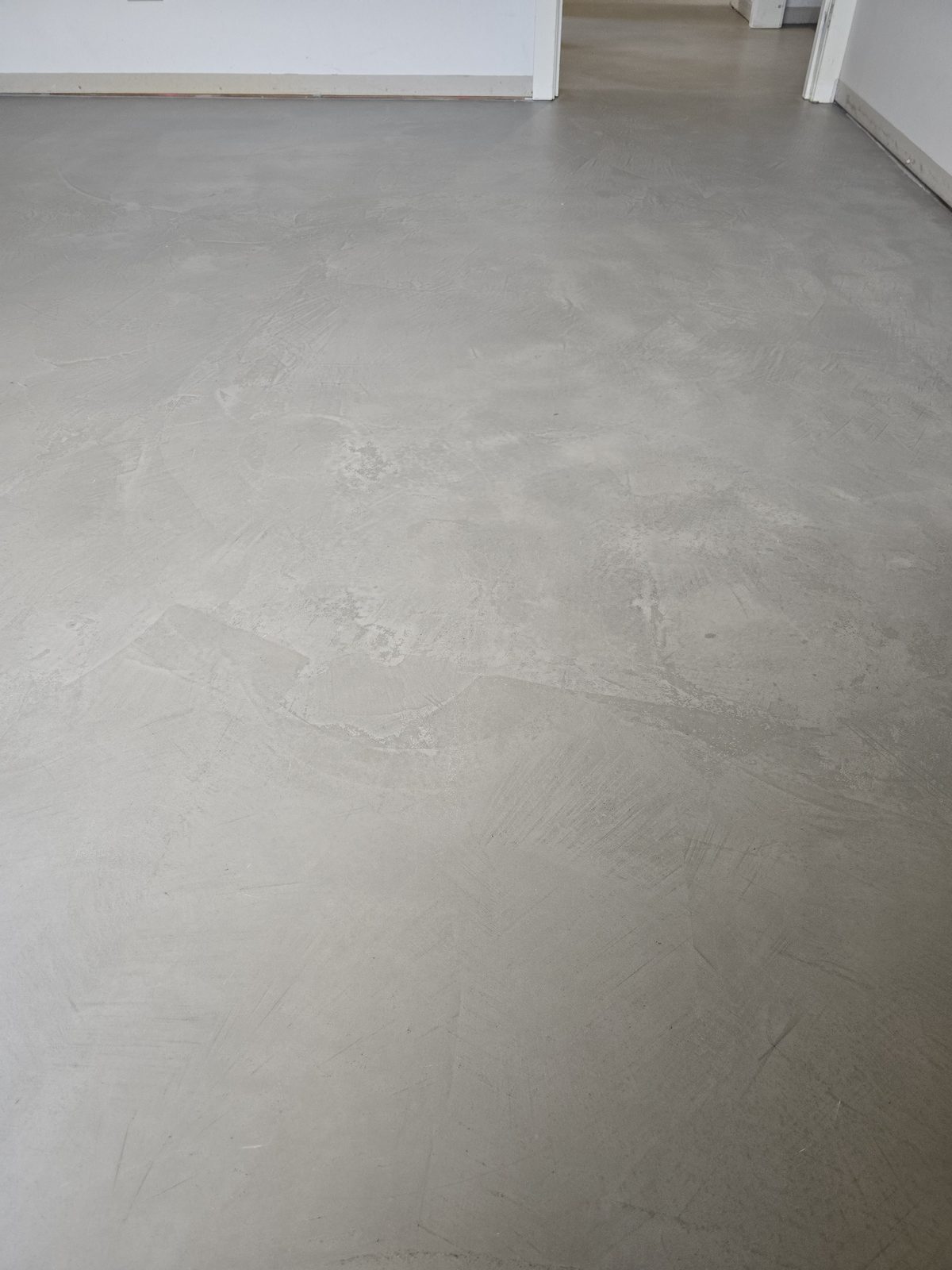
Microcement is hand-trowelled, and that is its charm: the trowel work gives every floor a subtly unique pattern — no two floors will ever look the same. It suits floors and walls alike, works where existing concrete is in too poor a condition to grind and seal or polish, and is a strong option where services have been chased into the floor or finishing heights are restricted.
Finishes range from smooth through to textures with a little more grit where extra surface friction is wanted.

Thickness, height tolerances and what it can’t do
Micro topping is a low-profile system — generally only 3–4mm thick — which makes it a practical option where height tolerances are limited around doors, window sills and adjoining floor levels. Where a floor covering would lift the level too far, this finish often still works.
It is a decorative resurfacing layer rather than a structural repair. It will not correct structural movement or major slab failure, so we assess your slab first and will recommend a levelling product, a different system, or specialist advice where that is the honest answer.

How microcement is installed
The sealer is where much of the real performance comes from — it provides the durability, abrasion resistance and stain resistance of the finished floor. It reduces staining rather than making the surface stain-proof, and the system still needs routine care.
- A professional-grade primer is applied to the prepared surface
- Multiple coats of microcement are applied by hand trowel, or by hopper gun where the finish and area suit it
- After curing, two to three layers of clear protective coating are applied
- The system is always finished with a topical sealer

Rasico decorative finish
Rasico is a distinctive decorative microcement-style finish suitable for selected interior and exterior applications.
Because it works in both settings, it is often asked about for pool surrounds, patios, balconies, pathways, feature floors and selected interiors, as well as wet areas where the system suits the conditions.
Whether Rasico is right for a particular area — and which texture and sealer go with it — is confirmed per project against the system and the manufacturer documentation. We do not claim that it meets every slip rating or suits every wet-area use, because that depends on the specification chosen for your floor.

How it compares with our other floor finishes
A concrete floor overlay is a thicker cementitious cap placed over an existing slab, and it can be ground back and sealed like concrete. Microcement is far thinner and stays a hand-applied decorative surface — choose the overlay when the slab needs more material over it, and microcement when height is tight or you want the trowelled look.
Grind and seal and mechanically polished concrete both work with the concrete you already have, grinding into the slab itself. Microcement covers the slab instead, which is why it suits floors that are too worn, patched or contaminated to finish attractively by grinding.
Caring for microcement
Care is similar to other overlaid surfaces such as timber floors: routine cleaning with a mop, water and a pH-neutral cleaner keeps the finish looking its best.
Why choose Premier Polished Concrete
Premier Polished Concrete was established in 2018 and is backed by over 20 years of building-industry experience and more than 100 completed projects. The business is fully insured. We’ll help you work out whether microcement — or another finish — is the right fit for your space.
Common questions
- Are microcement and micro topping the same service?
- For us, yes. Microcement, micro topping and microtopping all describe the same thin, decorative, cement-based overlay applied by hand over a prepared surface. The wording varies between manufacturers, designers and customers rather than describing different work.
- Can microcement be applied to floors and walls?
- Yes — it suits both, which is one of its advantages. It can run continuously across a floor and up a wall for a seamless look. Suitability still depends on the substrate and its condition, so we assess the surfaces first.
- How thick is a microcement or micro topping overlay?
- It is a low-profile system, generally only around 3–4mm. That makes it practical where height tolerances are tight around doors, window sills and adjoining floor levels, though the final build depends on the surface and the finish chosen.
- Can it repair structural movement or major slab failure?
- No. It is a decorative resurfacing layer, not a structural repair. It will not correct structural movement, and a moving crack can reappear through the finish. Where a slab has structural problems we will say so and point you to the right advice first.
- How is it different from a concrete floor overlay?
- A concrete floor overlay is a thicker cementitious cap over the slab that can be ground back and sealed like concrete. Microcement is much thinner and stays a hand-applied decorative surface. Choose the overlay where more material is needed over the slab; choose microcement where height is restricted or you want the trowelled look.
- How is it different from grind and seal or polished concrete?
- Grind and seal and mechanically polished concrete both work with the slab you already have, grinding into the concrete itself. Microcement covers the slab instead, which is why it suits floors too worn, patched or contaminated to finish attractively by grinding.
- Will every finished surface look exactly the same?
- No, and that is part of the character. Because it is hand-trowelled, each area carries its own subtle pattern and tonal variation, so no two finishes look exactly alike. We will talk through the look you are after before starting rather than promising uniform colour.
Ready for a quote?
Send through your details and any photos, and we’ll get back to you.
What Our Customers Say
Verified Google reviews for Premier Polished Concrete Grinding Microcement.
Ready to start your project?
Tell us about your space and finish, and we will get back to you. Local, fully insured, and happy to help.