

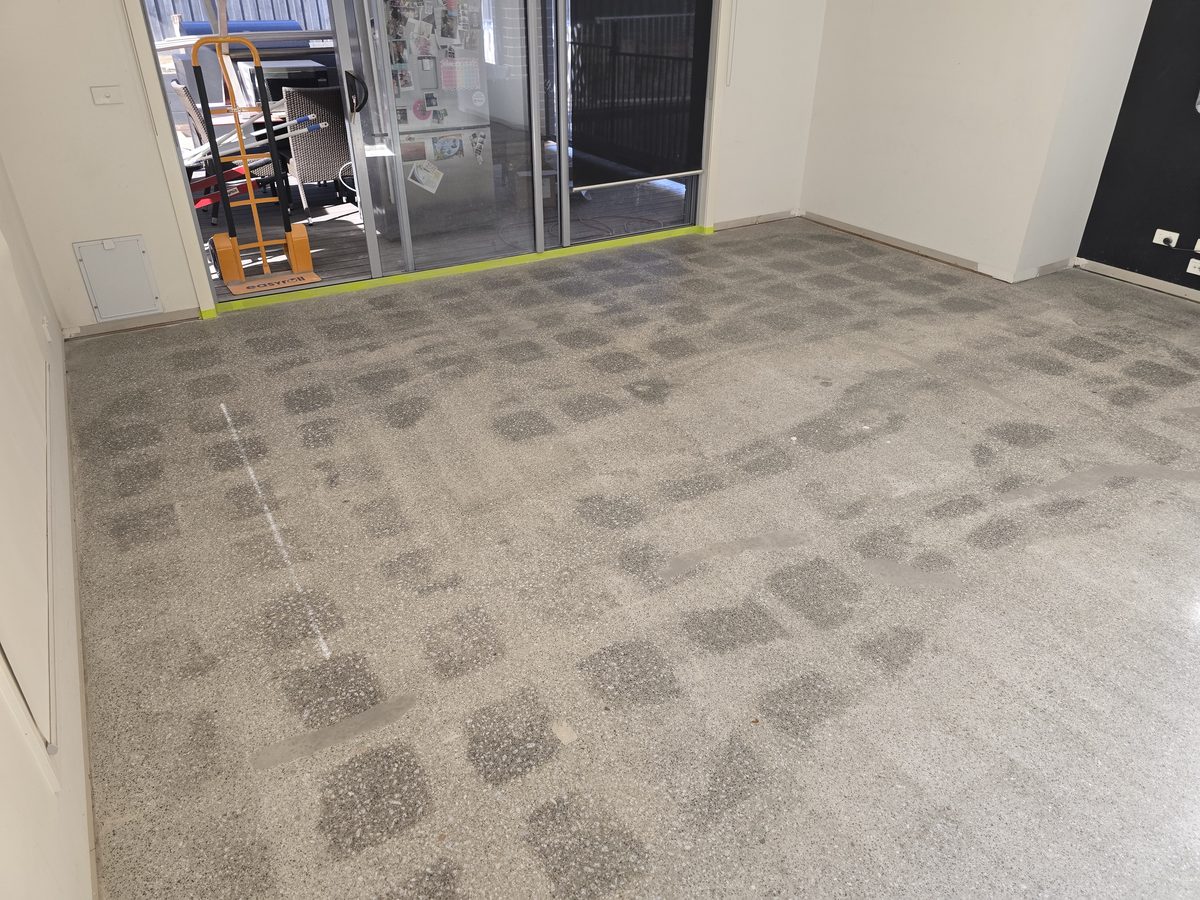

If you’ve lifted old carpet or tiles and found faint shadows, lines or blotches across the slab — or you’ve seen them appear once a floor was ground back — you’ve met concrete ghosting. On the Mornington Peninsula, where plenty of homes and commercial spaces are being renovated onto existing slabs, it’s a common surprise when a floor is prepared for polishing or coating. Ghosting is often permanent, or very difficult to remove consistently, and the honest answer to "can you get rid of it?" is usually "it depends on what’s causing it and how deep it goes." This guide explains what ghosting is, what it looks like, why it happens, and the realistic options for dealing with it. It’s written for homeowners first, but the same principles apply whether you’re a builder, designer or commercial property owner assessing a floor.
What is concrete ghosting?
Ghosting is a visible, persistent pattern in a concrete floor that shows up as a difference in colour, tone or texture compared with the surrounding slab. Often it traces the outline of something that used to sit on the floor — a wall, a hearth, a fixture — which is where the "ghost" name comes from. But the term is used more broadly than that. It also covers shadows, blotches and mottled patterns that come from the way the slab was built and cured, from contamination or previous use, or from old floor coverings and the adhesives beneath them. In other words, ghosting isn’t always a neat rectangle; it can be any lasting variation that reads as a mark once the floor is finished.
What does it look like?
Ghosting shows up in a few typical ways: straight lines or rectangles where old walls, hearths or partitions once sat; large soft patches where sheet vinyl, lino or carpet underlay covered the slab; darker or lighter blotches from spills, oils or old paint; and cloudy, mottled areas that only become obvious once the surface is ground or wetted. Some ghosting is barely noticeable on a raw slab and becomes clearer after grinding, because grinding cuts into the concrete and exposes variation that the worn top layer was hiding.

Common causes
Previous walls, fixtures and slab history. Where an internal wall, bath hob or hearth once stood, the concrete may have cured differently, been protected from wear, or been patched at some point. Different pours, repairs and patches rarely match the original slab exactly, so their edges can read as ghost lines.
Adhesives and floor coverings. This is the big one in renovations. Old tile glue, carpet adhesive, vinyl backing, bituminous ("cutback") adhesive and underlay can leave a lasting mark. Even after the covering and the bulk of the glue are removed, adhesive, plasticisers, oils or bituminous residue may have entered the concrete’s pores or caused persistent discolouration. The depth and effect vary from floor to floor. Our floor tile removal and floor preparation work often reveals exactly this kind of residue.
Contaminants and spills. Oil, grease, rust, paint and cleaning chemicals can migrate into the concrete. Metals can leave rust shadows; oils can leave darker patches that resist sealing.
Variations in curing and moisture. Concrete is a variable material. How a slab was poured and finished, where it dried faster or slower, where plastic or timber sat on it while it cured, and how moisture moves through it today all affect colour and density — and any of these can surface as ghosting.
A safety note on older floor coverings
In older Victorian properties, some vinyl tiles, sheet-flooring components, underlays and bituminous adhesives may contain asbestos. These materials cannot be identified reliably by appearance alone. Before any grinding or removal, suspect materials should be assessed or tested by a suitably qualified person. For guidance, see the Victorian Government’s asbestos information at asbestos.vic.gov.au. This matters for safety first, and it also affects how an old floor covering can be removed before a slab is prepared.
Why similar-looking areas of concrete can react differently
People are often surprised that two patches of the same floor, a metre apart, come up completely differently. That’s normal. A slab is a mix of cement, sand, aggregate, water and whatever it has been exposed to since it was poured. Local differences in the original mix, finishing, moisture, wear and contamination mean each area has its own history. Grinding exposes that history, and no two areas are guaranteed to respond the same way.
Why grinding, polishing or coating can reveal or intensify ghosting
It feels logical that grinding a floor back would remove marks. Sometimes it helps. But grinding also cuts into the concrete and exposes variation that wasn’t visible on the surface before. Polishing, densification and clear sealers then change how colour and contrast are perceived — a clear topical coating in particular can give a "wet-look" enhancement that deepens colour and makes a subtle shadow stand out more. Not every polishing system changes the floor the same way, but the general point holds: finishing an existing slab tends to reveal its character rather than hide it.

Why further grinding can’t guarantee removal
The instinct is to "just grind deeper." The problem is that grinding removes only a thin layer, and many ghosting causes reach deeper than that layer or vary right through the concrete. If a stain or colour variation extends well into the slab — or is a genuine difference in the concrete itself rather than a surface film — removing more material simply exposes more of the same variation. Deeper grinding also changes the aggregate exposure, and can affect levels, edges, thresholds and the intended finish, so whether it’s suitable at all has to be assessed for the particular slab. Extra cutting sometimes reduces ghosting, but it can’t be promised to remove it, and it can occasionally make things worse.
Surface residue versus variation within the concrete
This is the most useful distinction to hold onto. Surface residue — a film of adhesive, a smear of paint, loose grime — sits on top and can often be reduced or removed by cleaning, chemical treatment or grinding. Variation within the concrete — colour differences, penetrated stains, differences in density or moisture — is part of the slab itself, so there’s nothing on the surface to remove and it can’t be cleaned or ground away reliably. Much real-world ghosting is a mix of both, which is why results are hard to predict, and why a clear or translucent finish — which is designed to show the concrete — often displays ghosting with more contrast rather than concealing it.
What a test area can and can’t tell you
A test patch is genuinely useful: it shows how a particular area of this slab responds to grinding, densifying and sealing right now, and it helps set expectations. But it has limits. Because concrete varies across a floor, a good result in the test area doesn’t guarantee the same result everywhere, and a test patch can’t reveal how deep a stain goes or how the rest of the floor will behave. Treat it as a strong indication, not a warranty of the finished result.
More dependable options when ghosting is likely
When a slab shows significant ghosting and a uniform look matters, the more dependable path is usually to stop trying to see through the concrete and cover it instead. An overlay puts a fresh cementitious layer over the existing slab; a pigmented or opaque coating masks variation; and a deliberately decorative, non-uniform finish such as microcement can make character part of the design. These give far more visual control, but they aren’t automatic fixes: each still needs suitable preparation and an assessment of cracks, movement, moisture and compatibility with the slab, and none can be assumed to give complete concealment or long-term durability in every situation. The right choice depends on the floor and how the space is used.
Why expectations should be discussed before work begins
The single most important step is talking honestly about ghosting before grinding starts. Once grinding exposes deeper variation, returning the slab to its previous appearance may not be practical. A good contractor will inspect the floor, point out likely ghosting risks, explain that concrete is variable and that the final appearance depends on the slab’s history, and agree on a realistic finish — including a fallback such as an overlay or pigmented coating if a clear polished look can’t deliver an even result. Setting expectations early is what turns a potential disappointment into a planned, confident decision.
The honest summary
Ghosting is a possible feature of existing concrete, particularly where the slab has been covered, altered or exposed to contamination. Some of it can be improved; much of it is permanent or very hard to remove consistently, because it’s part of the slab rather than something sitting on it. The best outcomes come from inspecting the floor first, understanding what’s causing the marks, and choosing a finish that suits the slab you actually have — not the one you wish you had.
Frequently asked questions
Can ghosting be completely removed from a concrete floor?
Sometimes it can be reduced, but often it’s permanent or very hard to remove consistently. It depends on the cause and how deep it goes. Surface residue can frequently be improved; variation that’s part of the slab usually can’t be ground or cleaned away reliably.
Will polishing hide the marks in my slab?
Not usually. Polishing and clear finishes tend to make ghosting more visible, because they change how colour and contrast are seen and can add a wet-look depth. If an even look is the priority, a pigmented coating or an overlay is generally more dependable.
Why did the ghosting only appear after grinding?
Grinding cuts into the concrete and exposes variation that the worn surface was hiding, so shadows and stains that were faint on the raw slab can become clearer once the floor is cut and finished.
Could my old floor covering contain asbestos?
In older properties it’s possible — some vinyl tiles, sheet flooring, underlays and bituminous adhesives may contain asbestos, and they can’t be identified by sight. Have suspect materials assessed or tested before any grinding or removal. See asbestos.vic.gov.au.
Can you tell before you start whether my floor will ghost?
An inspection and a test area give a strong indication of how the slab is likely to behave, but because concrete varies across a floor, no one can guarantee a perfectly even result on an existing slab. That’s why we discuss expectations and fallback options up front.
Thinking about polishing or coating an existing slab? Send us details and photos for an initial assessment. Where required, we can inspect the floor, discuss potential ghosting and recommend realistic finish options. Get a free quote.
Related pages
Thinking about a concrete floor?
Tell us about your space and we will come back to you with a free, no-obligation quote.