


Concrete can crack for many reasons. Some cracking is associated with normal shrinkage or movement, while other cracking may require closer investigation. Its cause and significance depend on the slab and circumstances. Cracks and repairs can often be treated, but they can rarely be made invisible — and polishing tends to reveal a slab’s history rather than hide it. This guide explains why concrete cracks, the difference between planned and unplanned cracks, and how repairs tend to look once a floor is polished or sealed. It’s written for homeowners first but is just as useful for builders and designers on the Mornington Peninsula setting client expectations.
Why concrete cracks
Concrete is strong in compression but has limited tensile strength, and it changes as it cures and lives. Common, general reasons it cracks include shrinkage as the concrete cures and dries, movement and minor settlement over time, temperature and moisture changes, and loads or restraint acting on the slab. Some of this is routine; some points to something that needs a closer look. Importantly, working out why a particular crack has formed, and whether it matters beyond appearance, isn’t something to diagnose from a finish — significant cases are for a suitably qualified professional (more below).
Control or contraction joints versus unplanned cracks
Not all lines in a slab are "cracks" in the problem sense.
Understanding which you’re looking at matters, because a control joint is managed as a feature, while an unplanned crack is assessed and, where appropriate, repaired.
- Control or contraction joints are deliberately tooled or saw-cut to help manage where shrinkage-related cracking occurs. They do not guarantee that cracking will occur only at those joints, and they remain part of the finished look.
- Unplanned cracks form where stresses exceed what the concrete can take, away from those planned lines. These are the ones people usually mean, and they vary from fine and stable-looking to wider or moving.
Stable-looking versus moving cracks
Cracks broadly fall into ones that appear stable and ones that are still moving — and the distinction affects how a repair is likely to hold. A stable-looking crack that isn’t visibly widening may be suitable for filling and processing into the floor, but its appearance at one inspection does not prove that no future movement will occur. A moving crack — one subject to ongoing movement — is harder, because rigid fillers can re-crack as the slab moves, so the movement has to be considered in how it’s treated.
The key honesty point: assessing whether a crack is truly stable, actively moving, or a sign of a structural issue is not a judgement to make from the surface finish. This article doesn’t diagnose structural causes, and neither should a flooring assessment. Where movement, widening, displacement or other concerning signs are present, that’s a matter for specialist advice (see the last section).
Why cracks and repairs may still show after polishing
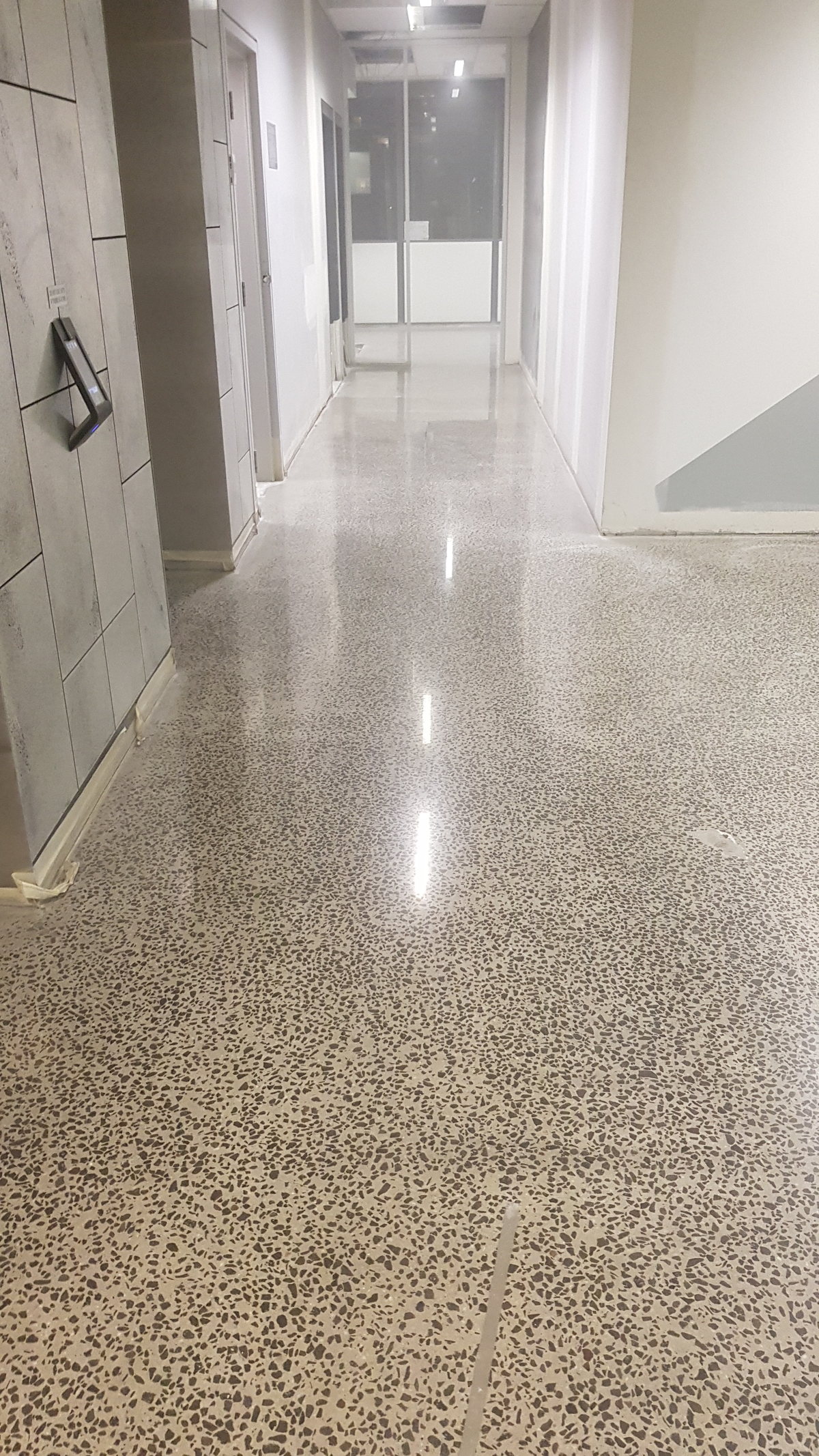
People sometimes hope polishing will "grind out" cracks and patches. Usually it won’t. A mechanically polished or clear-sealed floor takes its appearance from the concrete itself, so grinding into the slab tends to reveal its history — cracks, old repairs, colour variation and ghosting — rather than conceal it (our guide on ghosting explains why existing slabs are so unpredictable). A crack can be filled and made less obvious, and a repair can be blended, but the line or patch commonly remains detectable to some degree once the floor is finished.
Why colour, texture and aggregate matching is difficult
Even a careful repair rarely disappears, because a repair material is not the same as the surrounding concrete. Matching is difficult for several reasons: the original slab has its own cement colour, aggregate type, size and distribution, and surface texture, all set when it was poured; a repair or filler cures to its own colour and hardness and won’t contain the same aggregate arranged the same way; and once ground and polished, those differences in colour, sheen and stone can read differently side by side. A skilled repair narrows the gap — it doesn’t erase it.
Repair options, in general terms
Repairs are chosen to suit the crack and the finish, and are best discussed on the specific floor. In general terms they can include filling fine cracks, patching spalled or damaged areas, treating joints appropriately, and — where movement is a factor — using a treatment intended to accommodate some movement rather than a purely rigid fill. The right approach depends on the crack, the slab and the finish you’re heading toward, so it’s a conversation, not a one-size answer, and no specific product or outcome is promised here.
How different finishes display repairs
The finish you choose changes how much a repair shows:
In short: if you want the concrete’s natural character (MPC or clear grind and seal), repairs tend to show; if concealment matters, a pigmented coating or an overlay hides more — while none of them stops a genuinely moving crack from potentially reappearing.
| Finish | How cracks/repairs tend to show |
|---|---|
| Mechanically polished concrete (MPC) | The concrete is the surface, so a repair is processed into the floor but differences in colour, aggregate and texture commonly remain visible |
| Clear / translucent grind and seal | A clear coating lets the slab read through, so cracks, patches and variation are still visible much as with polishing |
| Pigmented / opaque coatings | A solid-colour coating conceals more of the surface variation, though cracks that move can still transfer through the film over time |
| Overlays | A cementitious overlay covers the existing surface and can present a fresh face, but it isn’t a cure for underlying movement, and moving cracks may still reflect through — see our overlays guide |
Why no repair should be promised as invisible
Because repair materials differ from the original concrete and finishes reveal or conceal to different degrees, no crack repair should be promised as invisible. A successful repair may make a crack or patch less noticeable, but the outcome depends on the slab, repair and finish. Agreeing what "acceptable" looks like — and viewing the specific slab — avoids disappointment.
What to agree before a repair
Because results vary, it helps to talk a few things through before any repair starts: which cracks or joints will be filled and which are better left as part of the floor’s character; the general approach for any crack that may move; roughly how noticeable a treated area is likely to remain; and how control joints will look in the finished floor. Agreeing this on the actual slab — ideally while looking at it together — means the finished result matches what you pictured rather than surprising you afterwards. It also lets you weigh whether a particular repair is worth it for the look you want, or whether a more concealing finish (a pigmented coating or an overlay) is the better route for that floor.
When specialist structural advice may be required
Some cracking is cosmetic; some is not. Signs such as cracks that are widening or moving, vertical displacement (one side higher than the other), cracking associated with slab heave or settlement, or anything that seems to affect the structure rather than just the surface, warrant advice from a suitably qualified professional — such as a structural engineer — before a decorative finish is applied over the top. A finish can’t fix a structural problem, and it shouldn’t be used to hide one. Getting the right advice first protects both the floor and your investment.
Frequently asked questions
Do polished concrete floors crack?
Concrete can crack whatever the finish, because that’s the nature of the material — through shrinkage, movement or loads. Control joints are planned to manage it; unplanned cracks can occur too. Polishing doesn’t prevent cracking, and it tends to reveal existing cracks rather than hide them.
Can cracks be repaired before polishing?
Usually, yes — stable cracks can be filled and processed into the floor, and damaged areas patched. Moving cracks are trickier and need treatment that allows for movement. Repairs make cracks far less obvious but not invisible, and the approach is decided on the specific slab.
Will the repair be invisible once it’s polished?
No repair should be promised as invisible. Repair materials differ from the original concrete in colour, texture and aggregate, and polished or clear finishes reveal those differences. A good repair is far less noticeable and becomes part of the floor’s character.
Which finish hides cracks best?
A pigmented (solid-colour) coating or an overlay conceals more surface variation than mechanically polished concrete or a clear grind and seal, which show the concrete’s character. None of them stops a genuinely moving crack from potentially reappearing over time.
When should I get a structural engineer involved?
If a crack is widening or moving, shows displacement, or seems linked to slab heave or settlement — anything beyond a cosmetic mark — seek advice from a suitably qualified professional before finishing over it. A floor finish can’t resolve a structural issue.
Concerned about cracks or an existing repair before committing to a finish? Send us photos and details of your slab, and where helpful we can look at it, talk through realistic repair and finish options, and set clear expectations for how the finished floor will look — and flag anything that warrants specialist structural advice first. Get in touch for a quote.
Related pages
Thinking about a concrete floor?
Tell us about your space and we will come back to you with a free, no-obligation quote.