

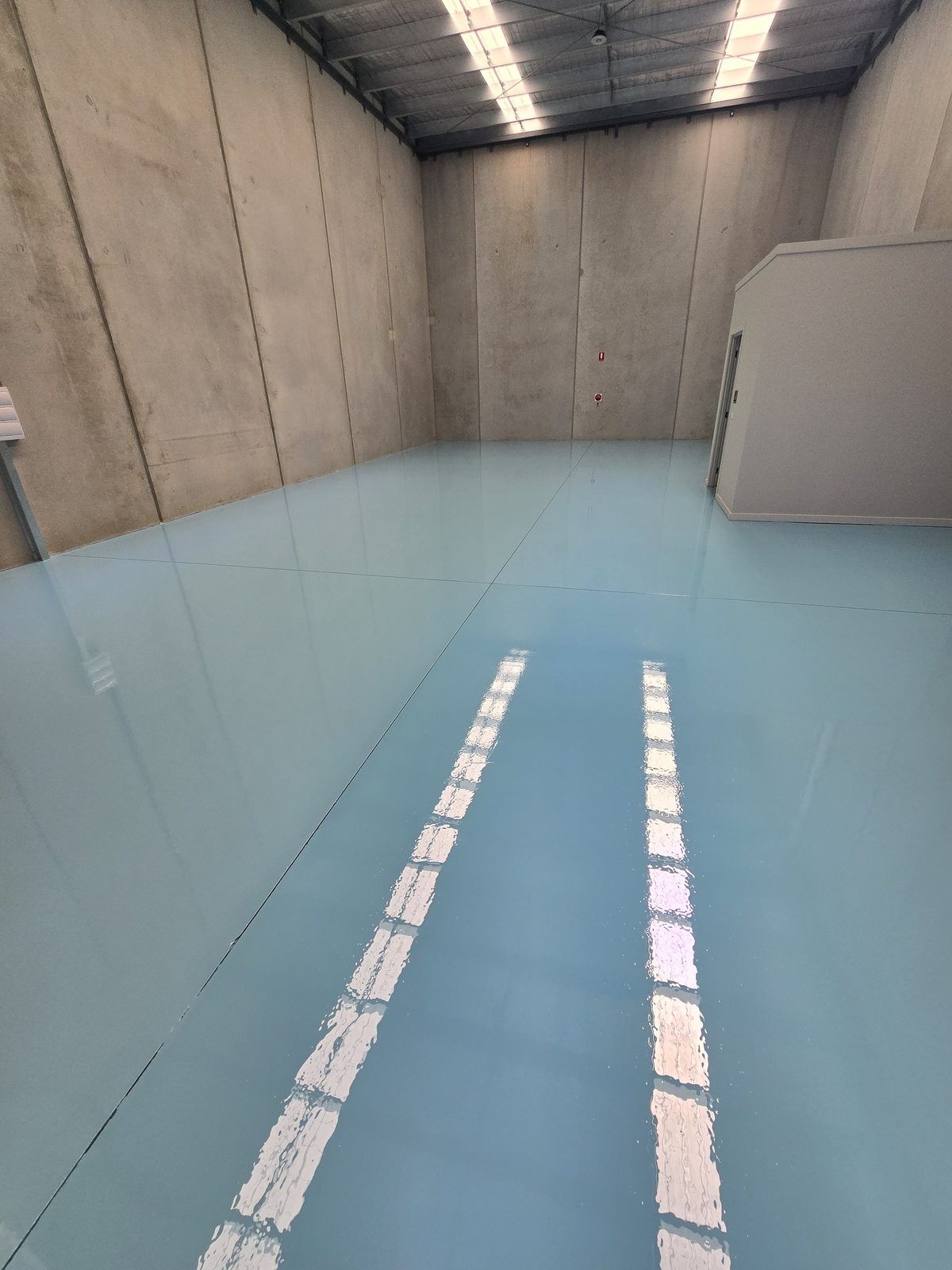

Polished concrete and epoxy are two of the most common ways to turn a bare slab into a finished floor, and they’re often compared head-to-head for homes, garages, workshops, shops and commercial spaces. They can both look sleek, and both start with a concrete slab — but they are fundamentally different things. One refines the concrete itself; the other is a resin coating applied over it. Neither is universally better. The right choice depends on the slab, the setting, the look you want, how the floor will be used and maintained, and your budget. This guide compares them impartially, for homeowners first, but with garages, workshops, retail, hospitality and commercial floors in mind too — including plenty of projects across the Mornington Peninsula.
The core difference in one line
Mechanically polished concrete (MPC) is a finish made from the slab — the concrete is ground and polished, and (typically) chemically densified, so the concrete itself becomes the wear surface. Epoxy is a finish made on top of the slab — a film-forming resin system bonded to the prepared concrete. That single distinction drives almost every practical difference below. (For the separate question of MPC versus grind and seal — another coated option — see our dedicated comparison, and for the coating families in general, our sealers-and-coatings guide.)
A note on the words "polished concrete"
"Polished concrete" is used loosely in the trade — sometimes for almost any smooth or shiny concrete floor, including coated ones. In this article, "polished concrete" means mechanically polished concrete specifically: a floor whose appearance and primary wear surface come from mechanically refined, densified concrete, not from a coating sitting on it. Keeping that precise is important, because an epoxy floor is not a polished-concrete system, even when it’s glossy.
What epoxy actually is
Epoxy is a film-forming resin flooring or coating system bonded to the prepared slab. A two-part epoxy is common, but an epoxy floor is usually a build of several compatible components rather than a single layer — it may include a primer, one or more epoxy body coats, broadcast media (colour flake or aggregate) cast into the resin, and a different topcoat over the top. Crucially, "epoxy" isn’t one product or one look. Systems vary widely: clear coats that let the concrete show through; pigmented (solid-colour) coats; decorative-flake systems where colour chips are broadcast into the coat and sealed; broadcast systems where aggregate or quartz is cast into the resin for texture and build; and heavier multi-coat build-ups for industrial use. Each can look and perform differently, so "an epoxy floor" can mean many things.
Epoxy also performs only as well as the complete system, not the resin alone: the surface preparation, the primer, the body coat, the film build (how much is applied), the topcoat, the conditions it’s applied in, and the use it’s designed for all shape the result. Two "epoxy floors" built to different specifications can behave very differently.
A note on our services: Epoxy is described as a service on our current website, but its present scope and the specific systems offered should be confirmed before relying on that information.
How they compare
Rather than crown a winner, it’s more useful to weigh the things that actually differ. What follows is general — real results depend on your slab, the specified system and the workmanship.
Appearance and substrate visibility. MPC has a natural, stone-like character that comes from the concrete and its aggregate (how much stone shows is a separate decision — see our aggregate-exposure guide). Epoxy’s look depends on the system: a clear epoxy can display the slab’s own variation — colour differences, ghosting, repairs and blemishes read through, much as a clear sealer does — while pigmented, flake or broadcast systems offer greater concealment, hiding slab imperfections behind colour and texture. So if you want the concrete’s character, MPC or a clear system shows it; if you want to mask a tired slab, a pigmented or decorative epoxy conceals more.
Preparation. Both need proper preparation — neither sits well over a dirty, contaminated or unsound surface. MPC prep is largely grinding the slab itself; epoxy relies on mechanically profiling and cleaning the concrete so the resin can bond, plus attention to moisture (below). In both cases, preparation quality is a major driver of the final result.
Cracks and repairs. Concrete cracks and moves, and neither finish makes that disappear. With MPC, repairs are processed into the surrounding floor but often remain visible in colour, aggregate and texture. With epoxy, a moving crack in the slab can transfer through the resin system and reappear at the surface, because the film follows the concrete beneath it. Existing cracks, patches and joints should be assessed and discussed before either floor is chosen.
Abrasion and wear. MPC is a hard, wear-resistant surface with no thick film to wear through — though it can still scratch and show wear, and isn’t maintenance-free. Epoxy’s abrasion resistance is system-dependent: suitable formulations can be very tough, but the film is a wear layer, and lighter systems mark more easily. Don’t assume either is universally more durable.
Stain and chemical exposure. MPC is not stain-proof; densifying and any applied guard reduce porosity, but spills — acidic ones especially — can still mark it. Epoxy, in suitable formulations, can offer strong stain and chemical resistance, but this is formulation-dependent and not a given for every product or every chemical. Match the specification to the actual exposure.
UV exposure. UV behaviour is product-specific — for the resin components of an epoxy system and for any guard or treatment applied to polished concrete alike. Exposed concrete itself does not undergo polymer yellowing, but its appearance can still change over time through weathering, moisture, staining and the behaviour of any applied treatments. Many epoxies are prone to yellowing or chalking under UV and are often better suited indoors unless specified otherwise — but you can’t assume a whole family behaves one way; check the specific product. Neither should be treated as automatically UV-stable outdoors.
Moisture. Moisture can affect either system and should be assessed before committing. In MPC it can influence appearance, cause efflorescence and interfere with applied stain protection. In a resin system, moisture moving through the slab can cause the epoxy to blister, lose adhesion or fail where conditions exceed the product’s specification — so slab moisture is a genuine go/no-go factor for coatings.
Slip resistance. Don’t assume either floor is non-slip. Neither system should be assumed to provide suitable slip resistance based on appearance or chemistry alone, and water, dust, oils and other contamination can reduce grip. Slip performance also depends on texture, any additives or broadcast aggregate, the finish, wear and cleaning — so where slip matters, it should be specified and verified for the setting, not taken for granted from a glossy photo.
Cleaning, maintenance and recoating. Both need routine cleaning. MPC has no thick film to recoat, but isn’t set-and-forget — it needs regular cleaning, its stain protection may require renewal, and some floors may require periodic mechanical maintenance or re-polishing. Epoxy is a wear layer that can be maintained and, when it ages or wears, renewed or recoated; how soon depends on the system, traffic and use. Think in terms of different maintenance rhythms rather than "low" versus "high."
Disruption to install. Both take multiple stages and time on site. MPC involves progressive grinding and polishing; epoxy involves preparation, coats and cure time between them and before return to service. The realistic timeline depends on the area, the slab and the system, so it’s best scoped per project rather than assumed.
Cost factors. We won’t quote prices, because cost turns on real variables: slab size, condition and preparation; crack repair; the exposure and sheen (MPC) or the system build, film thickness and topcoat (epoxy); site access and power; and the finish quality specified. The honest comparison is on your actual floor, including likely maintenance or recoating over time.
Comparison at a glance
General tendencies only — the real answer depends on the slab, the specified system and the workmanship.
| Consideration | Mechanically polished concrete | Epoxy flooring |
|---|---|---|
| What it is | A finish made from the densified, polished slab | A film-forming resin system bonded over the slab |
| Look / options | Natural, stone-like; exposure and sheen chosen | Clear, pigmented, flake or broadcast — very system-dependent |
| Shows the slab? | Yes — the concrete is the finish | Clear shows slab variation; pigmented/broadcast conceal more |
| Preparation | Mainly grinding the slab | Profiling, cleaning and moisture management for bond |
| Cracks | Repairs can remain visible | A moving crack can transfer through the film |
| Abrasion | Hard surface; can still scratch | System-dependent; the film is a wear layer |
| Stain / chemical | Reduced porosity; not stain-proof | Can resist well in suitable formulations; product-specific |
| UV | Doesn’t polymer-yellow; still weathers | Many yellow/chalk under UV; product-specific |
| Moisture | Assess; affects appearance/efflorescence | Assess; can blister or lose adhesion beyond spec |
| Slip | Not inherently non-slip; specify & verify | Not inherently non-slip; specify & verify |
| Renewal | No thick film; re-protect/re-polish | Wear layer; renew or recoat as it ages |
| Performance driver | Slab quality + polishing + densifying | The complete system: prep, primer, body, film build, topcoat, conditions, use |
Choosing for your setting
There’s no single right answer — work from the floor and how it’s used:
- Homes. For living areas, many people choose MPC for the natural concrete character; a decorative epoxy can suit where a specific colour, pattern or a hard-wearing coated look is wanted.
- Garages and workshops. Both are used here. Epoxy (often flake or a suitable coated build) is popular for a tough, wipe-clean, colour-controlled finish; MPC suits those who want the concrete itself refined. Chemical exposure, hot tyres, moisture and the look you want all steer the choice — as does the specific system.
- Retail and hospitality. Appearance, slip, cleaning and downtime tend to dominate. MPC offers a premium natural look; epoxy offers colour and pattern control. The setting’s slip and cleaning demands should be specified, not assumed.
- Commercial and industrial. Chemical exposure, abrasion, hygiene and moisture usually decide it, and the specification matters more than the label — a correctly designed system of either type, suited to the use, is what performs.
The bottom line
Mechanically polished concrete and epoxy aren’t two versions of the same thing — one refines the slab, the other coats it — and each has settings it suits. MPC gives a hard, natural concrete finish with no thick film to recoat; epoxy gives a resin system that can be clear, coloured or textured and is renewed as it wears, with performance riding on the whole specification. Decide the look and the demands first, be realistic about the slab (cracks, moisture and preparation especially), and confirm what’s suitable for your floor before committing — ideally after someone has looked at it.
Frequently asked questions
Is epoxy the same as polished concrete?
No. Mechanically polished concrete is a finish made from the slab itself by grinding, polishing and densifying it. Epoxy is a film-forming resin system applied over the concrete. "Polished concrete" is sometimes used loosely for shiny coated floors, but an epoxy floor isn’t a polished-concrete system.
Which is more durable — polished concrete or epoxy?
It depends on the slab, the specified system and the use. MPC is a hard surface with no thick film to wear through; a suitable epoxy system can be very tough but its film is a wear layer. Neither is automatically more durable, so match the choice to the setting.
Is epoxy good for a garage floor?
It can be — flake and other suitable epoxy systems are popular for garages — but not every epoxy suits every garage. Moisture in the slab, chemical and hot-tyre exposure, preparation and the specific system all matter, and MPC is also a garage option. It’s worth assessing the slab first.
Will epoxy hide cracks?
Not reliably. A moving crack in the slab can transfer through an epoxy system and reappear. Pigmented or textured systems hide surface blemishes better than clear ones, but cracking and slab movement are a separate issue to assess before coating.
Can either be used outdoors or in sunlight?
Only with the right specification. UV performance is product-specific; many epoxies can yellow or chalk in UV, and concrete finishes weather too. Outdoor and sun-exposed areas need a system chosen for those conditions — don’t assume either is UV-stable.
Do I need epoxy for a waterproof or non-slip floor?
Don’t assume either finish is waterproof or non-slip by default. An epoxy floor coating is not the same as a certified waterproofing system, and it should not automatically be treated as a waterproofing membrane or a moisture-remediation system. Moisture and slip both depend on the slab, the system and the setting, and should be specified and verified — not taken for granted.
Weighing polished concrete against epoxy for your space? Send us details and photos of your floor and how it’s used, and where helpful we can look at the slab, talk through appearance, moisture, slip and maintenance, and recommend a realistic option. Get in touch for a quote.
Related pages
Thinking about a concrete floor?
Tell us about your space and we will come back to you with a free, no-obligation quote.