

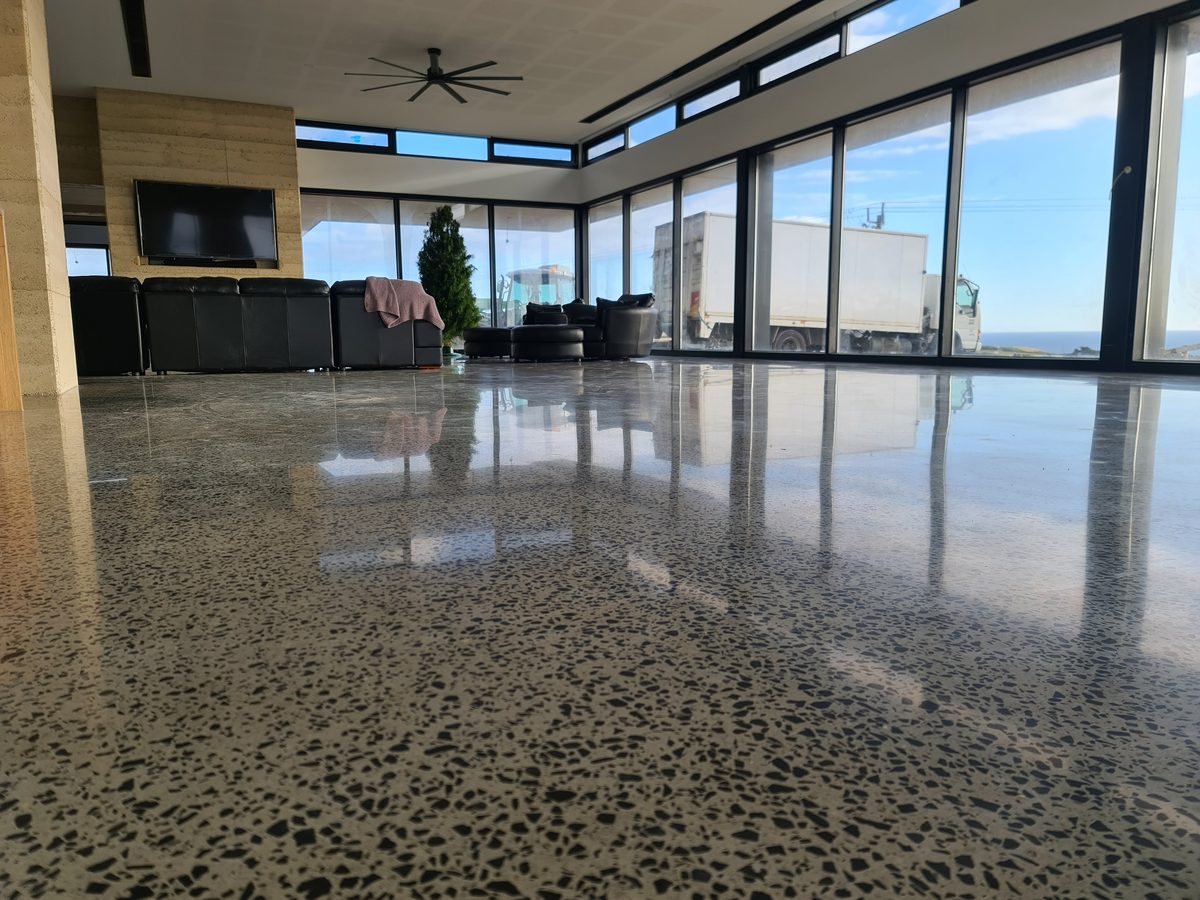

Samples and showroom floors are genuinely useful — they’re the best way to agree the look you’re after. What they can’t do is guarantee that your finished floor will match them exactly. That’s not a caveat to be nervous about; it’s simply the nature of concrete. A sample communicates a design direction — roughly how much stone, what sort of sheen, what colour feel — while your actual floor is its own piece of concrete with its own character. This guide, written for homeowners first but useful to builders and designers across the Mornington Peninsula, explains why, and what to agree before work begins so there are no surprises.
Concrete is a naturally variable material
Concrete is a site-placed material whose finished appearance is influenced by its constituent materials, placement, finishing and curing. Two floors — even two areas of the same floor — can differ in colour, tone and how much aggregate shows. Natural variation is characteristic of concrete, but whether a particular result is acceptable depends on the agreed specification, reference material, workmanship and site conditions.
What actually drives the differences
Several things shape how a given slab finishes, and they differ from slab to slab:
A sample was made from its mix, placed and finished its way, and cured in its conditions. Your slab has its own version of each, which is why it will have its own look even at the "same" nominated finish.
- Aggregate — the type, colour, size and distribution of the stone in the mix determine what an exposed or ground surface reveals.
- Mix — proportions and materials vary between batches and suppliers, affecting colour and behaviour.
- Placement — how the concrete is poured, moved and compacted influences where the aggregate ends up sitting.
- Finishing — screeding and trowelling affect the surface and how it will grind up.
- Curing — how the slab cures and dries affects final colour and consistency.
Samples and showroom floors: direction, not a precise copy
This is the key mental model. A hand sample or a showroom floor is excellent for agreeing:
What it can’t be is a pixel-for-pixel prediction of your finished floor, because it isn’t made from your slab. Use samples to confirm you and your contractor mean the same thing by a look — then hold them as a guide, not a contract for an identical result.
- roughly how much stone you want to see (the exposure direction),
- the sheen you’re drawn to (matte through to high gloss), and
- the general colour and mood.
Exposure and sheen are separate choices
It’s worth remembering that "how much stone shows" (exposure) and "how shiny it is" (sheen) are independent decisions — you can pair most exposure levels with most sheen levels. A sample helps you picture each, but they’re chosen separately, and our aggregate-exposure guide covers the exposure side in detail. Keeping the two apart when you look at samples makes it easier to communicate exactly what you want.
Existing slabs are especially unpredictable
If you’re polishing an existing slab rather than a new one, a sample is even less of a prediction. You’re working with concrete that’s already placed, finished and cured — often years ago, sometimes under coverings — so its aggregate, colour and flatness are already set and only partly knowable until work starts. Existing slabs can also carry history that a sample never will: colour variation, old repairs, adhesive residues and ghosting. Our guides on existing slabs and on ghosting explain why this makes them a case of discovering what’s achievable rather than dialling in a chosen look.
The value — and the limits — of a test area
For an existing floor, a test area can provide information from part of the actual slab. Premier rarely provides test areas; in limited circumstances one may be considered, but it cannot guarantee the result across the entire floor.
Its limits are worth stating too: a small test patch still can’t guarantee the whole floor will be uniform, because variation continues across the slab; edges and different areas may differ; and it’s a sample of the floor, not a promise about every square metre. Treat a test area as the best available preview, not a warranty of the final result.
Ghosting, repairs, edges and colour variation
A few specific things a sample will not predict and which may remain visible include:
Knowing these are expected — not signs of poor work — is half of being happy with a concrete floor.
- Ghosting — shadow-like marks from what sat on or in the slab, which grinding can reveal (see our ghosting guide).
- Repairs and patches — these read differently from the surrounding concrete and can remain visible (see our cracks and repairs guide).
- Edges and corners — done with smaller tools, so exposure and finish at the perimeter can differ slightly from the main floor.
- Colour variation — natural across any concrete slab, and part of the character.
Lighting and setting change how a floor reads
One more reason a sample can mislead is that the setting changes how any floor looks. A small board under bright, even showroom lighting reads differently from a whole floor in your home, where natural light, shadows, the size of the space and the angle you view it from all come into play. Sheen interacts with this too — a low sheen and a high sheen catch light very differently, so a surface that looked one way in a small sample can feel warmer, cooler, busier or calmer across a real room. Where you can, view samples (and any test area) in the actual space and light they’ll live in, rather than judging from a showroom alone — it’s a better guide to how the finished floor will feel.
What to agree before work begins
The way to avoid disappointment is to align expectations up front. Before work starts, it’s worth agreeing:
Agreeing these turns a naturally variable material into a predictable experience, even if the floor itself can’t be perfectly predicted.
| Agree in advance | Why it matters |
|---|---|
| The design direction (exposure + sheen) using samples/photos | So everyone means the same look |
| That the slab governs the result | Samples are a guide, not a guaranteed match |
| Whether a test area may be worthwhile in limited circumstances | Information from one part of the actual slab, not a guarantee |
| That variation, edges, ghosting and repairs may remain visible | Agree the expected and acceptable outcome |
| What "acceptable" looks like | A shared, realistic standard to work to |
The bottom line
Samples and showroom floors are useful for choosing a direction, but they cannot perfectly predict a finished concrete floor because every slab is different. Decide the look you want, understand the limits of reference material and agree what “acceptable” means before work begins. In limited circumstances, a test area may be considered, but it cannot guarantee the result across the entire floor.
Frequently asked questions
Will my polished concrete floor look exactly like the sample?
It will follow the same direction — similar exposure, sheen and colour feel — but not match exactly, because your floor is made from its own concrete, placed and cured on site. Samples agree the look; the slab decides the detail.
Are samples useful at all, then?
Very. They’re the best way to agree what you’re after — how much stone, what sheen, what colour mood — and to check you and your contractor mean the same thing. Just treat them as a guide rather than a guaranteed copy.
Is a test area better than a sample?
It can provide information from the particular area tested, but it cannot predict the entire slab. Premier rarely provides test areas; in limited circumstances one may be considered.
Why might my floor vary across the room?
Variation in aggregate, colour and finishing can occur, and edges completed with smaller tools may differ from the main field. Existing slabs may also show ghosting or old repairs. Whether a result is acceptable depends on the agreed scope, specification, workmanship and site conditions.
How do I avoid disappointment?
Agree the design direction with samples, use a test area where it helps, and — importantly — agree beforehand that variation, edges, ghosting and repairs are expected, and what an acceptable result looks like. Aligning expectations up front is the key.
Trying to picture how a finish may look on your slab? Send us details and photos for an initial review. Where required, we provide an on-site assessment before preparing or confirming the quote.
Related pages
Thinking about a concrete floor?
Tell us about your space and we will come back to you with a free, no-obligation quote.