

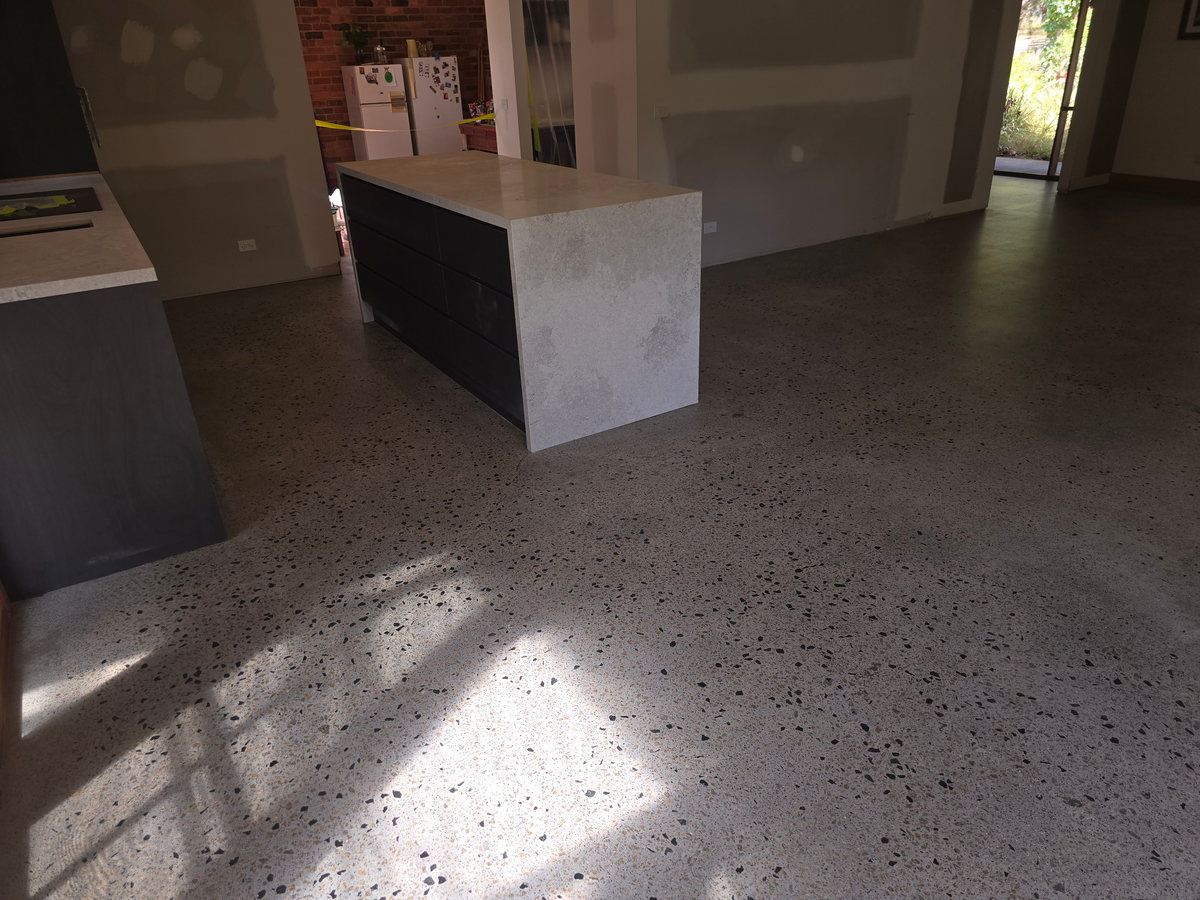

It is the most common either/or question we get, and the honest answer is that neither wins everywhere. Polished concrete uses the slab you already have, which is where it saves money and where it shows its limits. Tiles add a second material on top, which costs more in some situations and is simply the right tool in others. This guide sets out how the two actually compare, so you can decide for your floor rather than for a floor in a photo.
The short answer
Polished concrete is usually the better choice when you have a sound concrete slab, an open-plan space, and you want one continuous surface that is easy to keep clean. Tiles are usually the better choice when there is no slab to polish, when a room needs a certified wet-area system, when the space is small, or when you need a uniform colour that concrete cannot promise.
Cost sits in between and depends on the slab more than on the finish. A good slab in a large open area is where polished concrete is at its most economical; a damaged slab in a cut-up space can cost more to prepare than tiling it would.
Cost: why the comparison is not a single number
A tiled floor is priced as tiles plus adhesive, grout, waterproofing where required, and the tiler’s labour. Those are fairly predictable, which is why tiling quotes tend to land close together.
Polished concrete has no second material — the floor is the slab — so the cost is almost entirely work. That work depends on the slab’s condition, how much preparation it needs, the finish level you choose, the size and shape of the area, and access for machinery. A large, sound, simple floor is efficient; a small, cut-up, patched one is not. Our guide to what affects polished concrete cost goes through each driver.
The costs people forget are the same for both: removing what is on the floor now, and dealing with what that removal reveals. If an old tiled floor is coming up, the adhesive has to be ground off before either finish goes down.
The practical advice is to get both quotes on the same area with the same preparation included, then compare like with like. We will tell you if the slab makes polishing the expensive option.
Comfort, warmth and sound
Both are hard, cool surfaces. Neither is soft underfoot and both reflect sound in a large room, so rugs do the same job on either.
The difference is thermal mass. A concrete slab stores heat — from winter sun through glass or from in-slab heating — and releases it slowly, which is why polished concrete suits passive-solar designs. Without a heat source it is a cold floor in winter, and so is a tiled one; tiles over a slab behave much the same way because the slab is still underneath.
Maintenance and cleaning
The everyday difference is grout. A polished or sealed concrete floor has no grout lines to trap dirt or discolour, which is the single reason most people who switch do not go back. Tiles themselves are inert and easy; it is the grout that needs scrubbing and eventually re-grouting.
Concrete has its own upkeep. A grind-and-seal floor relies on its sealer, which wears and needs re-coating at an interval set by traffic. A mechanically polished floor is densified and hardened rather than coated, so there is no film to wear through, but it still needs the right cleaning routine and prompt attention to spills. Neither is maintenance-free, and our maintenance guide sets out what each actually needs.
Repairs and changes
Tiles can be replaced one at a time if you kept spares, and the repair is invisible if the batch matches. Their failure modes are cracked and drummy (loose) tiles, and once a floor starts losing tiles, replacing them individually becomes a losing game.
Concrete does not crack because you dropped something, but the slab’s own cracks show through the finish and cannot be hidden, only filled and made tidy — see cracks and repairs in polished concrete. You cannot replace a section of polished concrete invisibly the way you can swap a tile; a localised repair will read as a repair. What you get in exchange is a floor with nothing to come loose.
Wet areas: bathrooms and laundries
Tiles are the conventional wet-area system in Australia: a waterproofing membrane underneath, falls to the drain, and a surface designed for it. That is a known, certified approach and for most bathrooms it is the sensible default.
Concrete-based finishes can be used in wet areas — microcement in particular is popular for seamless bathrooms — but they must be specified as a wet-area system, with the waterproofing and sealing designed for it rather than assumed. Slip performance has to be considered separately for any wet floor; our guide to slip resistance explains why no finish should be called non-slip.
Appearance: predictable versus revealed
Tiles are a manufactured product. What you see in the showroom is what arrives, batch variation aside. If you need a precise, uniform colour across the whole floor, that predictability is a genuine advantage.
Polished concrete reveals what is in the slab: the aggregate, the colour of the cement, pour lines, patches, and the history of what has sat on it. Old tile adhesive can ghost through a finished floor, and samples cannot promise a match. That variation is the appeal for most people and a deal-breaker for some. Decide which you are before you decide on the floor.

What about concrete-look tiles?
Large-format porcelain that looks like concrete exists and is well made. It is still a tile: grout lines, a manufactured surface, replaceable pieces, a wet-area system available. Choose it because you want tile properties with a concrete look — not as a cheaper polished concrete, because on a good slab it rarely is.
Longevity and resale
Both last a long time when looked after. A polished slab is the structure of the house; it does not go out of date in the way a tile colour can, though sealers and finishes still need maintenance. Tiles can last decades too, and can also date a room.
On resale we will not quote a figure, because there is no reliable one. Polished concrete is widely wanted in new and renovated homes; whether it adds measurable value depends on the buyer, the house and the quality of the floor.
When tiles are the better choice
- There is no slab — a house on stumps with a timber floor cannot be polished.
- The slab is in poor condition, heavily patched or contaminated, and preparing it would cost more than it is worth.
- The room needs a certified wet-area system and you want the conventional, well-understood approach.
- The area is small and the fixed cost of bringing machinery in dominates the job.
- You need a uniform colour or pattern that concrete cannot promise.
- Old adhesive ghosting would show, and you are not prepared to live with it.
When polished concrete is the better choice
- A new build where the slab can be planned for polishing from the start.
- A sound existing slab in a large, open-plan area.
- You want one seamless surface with no grout to maintain.
- A busy household — kids, dogs, sand — where easy cleaning matters more than softness.
- A design that uses the slab’s thermal mass.
- You like the character of concrete and accept that no two floors are the same.
At a glance
| Polished concrete | Tiles | |
|---|---|---|
| What it is | The slab itself, ground and finished | A second material laid on the slab |
| Cost driver | Slab condition, preparation, area, finish level | Tile price, labour, waterproofing, area |
| Grout | None | Needs cleaning and eventual re-grouting |
| Repairs | Cracks filled, not hidden; sections not replaceable | Individual tiles replaceable if spares match |
| Wet areas | Possible with a specified system (e.g. microcement) | Conventional certified system |
| Appearance | Revealed — varies with the slab | Manufactured — predictable |
| Needs a slab | Yes | Yes, or a suitable substrate |
Frequently asked questions
Is polished concrete cheaper than tiles?
Sometimes. On a sound slab in a large open area it often is, because there is no second material to buy and lay. On a damaged slab, or in a small or cut-up space, the preparation and setup can make it the dearer option. Get both quotes on the same area with the same preparation included.
Can I polish the concrete under my existing tiles?
Often, but it depends on what is underneath. The tiles and adhesive come up, the adhesive is ground off, and then the slab decides: its condition, finish and any ghosting left by the adhesive. An inspection answers it before anyone commits.
Is polished concrete colder than tiles?
Not meaningfully — tiles over a slab behave much like the slab. With sun or in-slab heating, concrete’s thermal mass is an advantage; without a heat source both are cold floors in winter.
Which is easier to keep clean?
Polished or sealed concrete, mainly because there is no grout. It is not maintenance-free: sealed floors need periodic re-sealing and all concrete floors need spills dealt with promptly.
Can you have polished concrete in a bathroom?
Concrete-based finishes can be used in wet areas when they are specified as a wet-area system — microcement is the usual choice — with waterproofing, sealing and slip performance designed for it rather than assumed. For many bathrooms, tiles remain the simpler answer.
Weighing up tiles against polished concrete for a particular room? Send photos of the space and tell us what is on the floor now. We will say honestly whether the slab suits a polish — and if tiles are the better answer, we will say that too. Get a free quote.
This guide is general information based on our experience on the Mornington Peninsula, not advice for a specific project. Every slab is different, product performance depends on the manufacturer’s specifications, and we assess each floor on site before quoting.
Related pages
Thinking about a concrete floor?
Tell us about your space and we will come back to you with a free, no-obligation quote.